
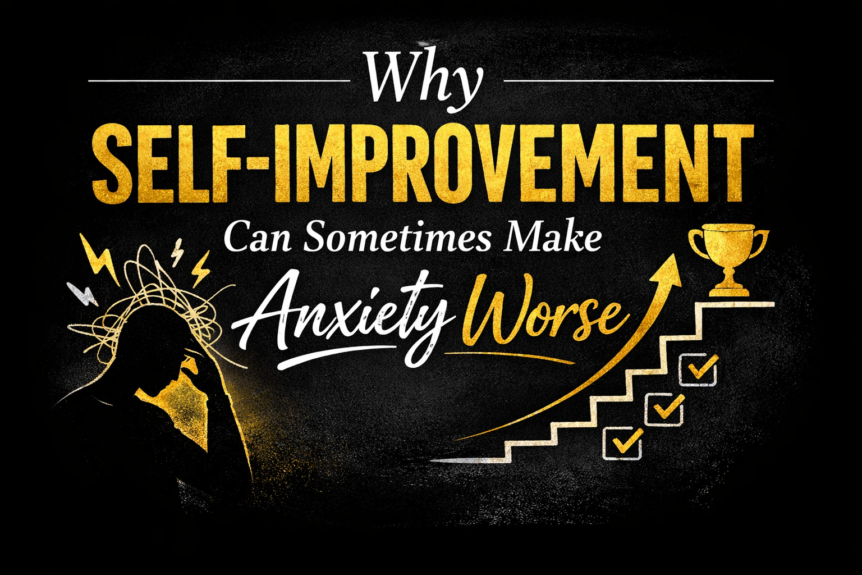
If you’ve been doing all the things you’re meant to do — therapy, journaling, mindset work, self-help books, healing tools — and yet you feel more anxious rather than calmer, something can start to feel very wrong.
On the surface, it doesn’t make sense.
You’re trying to improve yourself. You’re being reflective. You’re taking responsibility for your wellbeing. And yet, instead of relief, there’s a growing sense of pressure. Instead of ease, more tension. Instead of clarity, more internal noise.
For some people, self-improvement genuinely helps reduce anxiety. But for others, it seems to have the opposite effect — leaving them feeling more hyper-aware, more self-conscious, and more on edge than before. If that’s been your experience, it can be deeply confusing.
You might start to wonder:
-
Why do I feel worse the more I work on myself?
-
Why isn’t this helping the way it’s supposed to?
-
Am I doing it wrong?
-
Is there something broken in me that other people don’t have?
These questions often stay unspoken. From the outside, it looks like you’re doing “healthy” things. From the inside, it can feel like you’re constantly monitoring yourself — checking whether you’re calmer yet, more healed yet, less anxious yet.
And that’s often where the quiet fear creeps in:
If self-improvement is meant to help, and it’s making my anxiety worse… what does that say about me?
If you’ve ever had that thought, there’s something important I want you to know early on:
This experience is far more common than people realise — and it’s not a personal failure. There is a very real reason why self-improvement can sometimes increase anxiety, especially when the nervous system is already under strain.
And no — it doesn’t mean you’re broken.
This doesn’t mean self-improvement is bad — or that you’re failing
If self-improvement has made your anxiety worse, it’s important to say this clearly and early:
This is a common experience.
Many people quietly struggle with increased anxiety after therapy, self-help work, or personal development — even though it’s rarely talked about openly. Because the culture around self-improvement is so positive, people often assume that if it isn’t helping, they must be doing something wrong.
They’re not.
Self-improvement itself isn’t the problem. Reflection, awareness, and growth can be genuinely supportive when they’re aligned with the body’s capacity. And feeling more anxious doesn’t mean you’ve failed at healing, or that you lack insight, commitment, or discipline.
What it usually means is something much simpler — and much kinder:
Your nervous system is under too much pressure.
From a nervous-system perspective, rising anxiety is rarely a sign of laziness or resistance. It’s more often a sign that the system is overloaded, stretched, or being asked to change faster than it feels safe to.
So when people ask, “Can self-help make anxiety worse?” the honest answer is:
Yes — it can, especially when the body is already in a state of heightened alert.
That doesn’t mean the work is wrong. It means the conditions the work is happening in matter.
Anxiety increasing is not a reflection of how hard you’re trying. In fact, many of the people most affected by this are the ones who are trying the hardest — reading the books, doing the practices, applying the insights, and genuinely wanting to feel better.
When anxiety rises in this context, it’s often the nervous system signalling:
This is too much, too fast, or too constant.
Understanding that difference is where self-blame begins to loosen. And when self-blame eases, the nervous system already has a little more room to breathe.
Why self-improvement feels like the right answer
When anxiety is present, self-improvement doesn’t appear out of nowhere. It makes sense — especially in the world we live in.
We’re surrounded by cultural messaging that tells us:
-
If something feels uncomfortable, it needs fixing
-
If you’re struggling, you should work on yourself
-
If you optimise your habits, mindset, or behaviour, you’ll feel better
Growth, in this context, is framed as responsibility. Improvement is framed as safety.
So when anxiety shows up — bringing uncertainty, restlessness, and a sense that something isn’t quite right — turning to self-help or personal development can feel like the most logical response. It offers structure. It offers direction. It offers the reassurance that there’s something you can do.
From a nervous-system perspective, this matters.
An anxious system is already scanning for ways to regain stability. Self-improvement promises exactly that: control in the face of uncertainty. A plan. A method. A sense of forward movement when things feel stuck or unpredictable.
This is one of the reasons people with anxiety are often deeply committed to growth. They’re not avoiding the work — they’re engaging with it wholeheartedly. They read, reflect, apply, and try again. They’re willing to look at themselves honestly. They want to understand what’s happening inside them.
In many ways, this makes them very good at self-improvement.
But there’s a subtle shift that can happen over time. What begins as support can gradually turn into pressure. What begins as care can become a constant internal demand to improve, regulate, and stay on top of yourself.
Not because you’re doing anything wrong — but because anxiety and self-improvement both revolve around control. And for a nervous system that already feels unsafe, the drive to gain control can quietly intensify the very state it’s trying to resolve.
Understanding this isn’t about judging self-help or personal growth. It’s about recognising why it feels so compelling — and why, for some people, it eventually stops feeling supportive.
Where self-improvement starts to go wrong
Self-improvement becomes anxiety-provoking not because growth is bad, but because of the state the nervous system is in while the growth is happening.
This is the distinction that often gets missed.
From the nervous system’s point of view, intention doesn’t matter nearly as much as orientation. The body doesn’t register “I’m trying to grow” or “I’m working on myself in a healthy way.” It responds to the underlying signals it’s receiving.
And when self-improvement is driven by threat rather than safety, those signals can quietly sound like this:
You’re not okay yet.
Something needs fixing.
Stay alert.
Even when the practices themselves are gentle, reflective, or well-intentioned, the nervous system doesn’t hear “growth.” It hears pressure.
This is why self-improvement can increase anxiety rather than reduce it. An anxious nervous system is already on high alert. When the work you’re doing carries an implicit message that you need to be different in order to be safe, the body interprets that as confirmation that danger is still present.
So instead of settling, it stays activated.
This doesn’t happen consciously. You’re not choosing it. There’s no flaw in your mindset. It’s simply how the nervous system is designed to work. It prioritises protection over progress, and safety over insight.
When self-improvement comes from a place of “I need to fix myself,” the body stays vigilant. When it comes from a place of “I’m allowed to be as I am while change unfolds,” the system has permission to soften.
That difference — threat versus safety — is often what determines whether self-help calms anxiety or quietly intensifies it.
And once you understand that, a lot of what hasn’t made sense before starts to fall into place.
Common self-improvement patterns that increase anxiety
When self-improvement starts to increase anxiety, it rarely looks dramatic. More often, it shows up in small, socially acceptable habits that are praised as “self-awareness” or “doing the work.”
But from a nervous-system perspective, many of these patterns keep the body in a state of quiet alert.
Here are some of the most common ones.
Constant self-monitoring
Questions like:
-
Am I regulated yet?
-
Should I be calmer than this?
-
Why am I still anxious?
can begin to run in the background of your day.
This kind of internal checking is often mistaken for mindfulness, but for an anxious nervous system it functions more like surveillance. The body stays on watch, scanning for whether something is still wrong — and that ongoing attention alone can keep anxiety active.
Tracking emotions obsessively
Tracking feelings can be useful in certain contexts, but when it becomes constant, it can reinforce the idea that your internal state needs to be managed at all times.
Instead of allowing emotions to move through naturally, attention stays fixed on them. The nervous system never gets the message that it’s allowed to relax, because awareness has turned into continuous monitoring rather than gentle noticing.
Turning rest into a task
Rest is one of the first things to become performance-based.
You might notice thoughts like:
-
Am I resting properly?
-
Am I doing this regulation exercise right?
-
Why doesn’t this feel calming yet?
When rest becomes something you have to get right, it stops functioning as rest. The nervous system experiences it as another demand — another moment where it’s being assessed.
Consuming too much advice
In an attempt to feel better, it’s easy to take in large amounts of self-help content: podcasts, posts, books, techniques, frameworks.
While each piece may be helpful in isolation, too much input can overwhelm an already sensitive system. Instead of clarity, there’s confusion. Instead of grounding, there’s more mental activity.
The body stays alert because it never gets a chance to integrate — it’s always being given something new to consider.
Comparing your healing timeline to others
Watching other people seem calmer, more regulated, or “further along” can quietly create pressure.
Even if you know intellectually that healing isn’t linear, comparison can trigger a sense of urgency:
Why am I not there yet?
From a nervous-system point of view, this reinforces threat. The body feels behind, insufficient, or at risk — which increases anxiety rather than reducing it.
Feeling pressure to use every tool correctly
When you’re committed to healing, it can start to feel important to apply every insight properly, use every technique effectively, and make the most of every opportunity to improve.
But this creates an internal environment where there’s little room to simply be. The nervous system stays engaged, alert to whether you’re doing things “right,” rather than settling into safety.
Why these patterns feel supportive — but aren’t always regulating
None of these behaviours mean you’re doing something wrong. In fact, they often come from a genuine desire to care for yourself.
The issue isn’t the tools. It’s the constant pressure placed on the system to change, improve, or settle — without enough space to rest in safety first.
When self-improvement keeps the nervous system under observation, anxiety doesn’t get the chance to resolve. It stays active, not because you’re failing, but because the system never receives the signal that it’s allowed to stand down.
And for many people, simply recognising these patterns is the first moment of real relief.
The hidden cost of “fixing yourself”
When self-improvement is driven by the belief that something about you needs fixing, the effects aren’t always immediate. They tend to accumulate quietly, over time.
One of the first things that erodes is internal trust.
Instead of trusting your body’s signals, you may start to question them. If you feel anxious, tired, or overwhelmed, the response becomes analytical rather than relational:
What does this mean? What should I do about it? How do I get rid of it?
The body stops being experienced as an ally and starts to feel like a problem to manage.
Alongside this, hypervigilance increases. There’s a subtle sense of always watching yourself — your reactions, your emotions, your level of regulation. Even moments of relative calm can feel unstable, because you’re aware they might not last.
From a nervous-system perspective, this means the body never fully receives the signal that it’s safe to stand down.
Instead, it stays on low-level alert:
-
Monitoring for symptoms
-
Checking for progress
-
Bracing for setbacks
Over time, this creates the feeling of always being under assessment — as though there’s an internal scorecard measuring how well you’re doing at healing or self-improvement.
And the nervous system responds to assessment the same way it responds to threat.
It doesn’t relax.
It stays ready.
This is why anxiety can escalate the longer this cycle continues. Not because you’re resisting healing, but because the body is being asked to change while remaining under constant observation.
Without periods of genuine safety — moments where nothing needs to be fixed, monitored, or improved — the system doesn’t have the conditions it needs to settle. Anxiety becomes the by-product of never being allowed to rest from the work of becoming “better.”
Understanding this isn’t about blaming yourself for trying. It’s about recognising that even well-intentioned self-improvement can come at a cost when it’s rooted in pressure rather than care.
And once you see that, a different, gentler path becomes possible.
The reframe: safety before change
One of the most important shifts — and one that’s rarely emphasised in mainstream self-improvement — is this:
Regulation comes before transformation.
From the nervous system’s point of view, change doesn’t happen through force or effort. It happens when the body senses enough safety to let go of its protective strategies.
When safety is present, the nervous system naturally begins to soften. Patterns loosen without being pushed. Emotions move without being managed. Insight integrates without pressure.
This is why so many people feel frustrated with self-help. They’re trying to create change in a system that’s still braced. And a braced system doesn’t transform — it protects.
Healing, in this sense, is often receptive rather than effort-based. It’s less about doing more, analysing more, or understanding more, and more about allowing the body to experience moments where nothing needs to be fixed.
This is also why doing less can sometimes create more change.
When you reduce the constant demand to improve, monitor, or regulate yourself, the nervous system finally receives a different message:
I’m allowed to be here as I am.
And that message alone can be deeply regulating.
This doesn’t mean abandoning growth or awareness. It means recognising that sustainable change arises from safety, not self-surveillance. From permission, not pressure.
For many people, this reframe is the first time healing stops feeling like hard work and starts feeling like something that can unfold naturally, in its own time.
And once safety becomes the foundation, anxiety no longer has to be pushed away. It begins to settle because the conditions that created it are no longer being reinforced.
What it can look like to step out of the cycle (gently)
Stepping out of the self-improvement–anxiety cycle doesn’t usually happen through a dramatic decision or a new technique. More often, it happens through small orientation shifts — quiet changes in how you relate to yourself.
One of the first shifts is moving from fixing to listening.
Instead of asking, “What’s wrong with me?” the question softens into, “What is my system communicating right now?” Anxiety is no longer treated as a problem to solve, but as information to be received. This alone can reduce nervous-system pressure, because the body is no longer being argued with.
Another shift is moving from effort to responsiveness.
Rather than pushing yourself to regulate, heal, or optimise, you begin responding to what’s actually present. Some days that might look like slowing down. Other days it might mean doing less inner work, not more. The goal is no longer improvement — it’s attunement.
There’s also a quieter, but deeply powerful element here: permission.
Permission to pause the constant self-monitoring.
Permission to stop tracking your emotions, your regulation, your progress.
Permission to not work on yourself for a while — without interpreting that as avoidance or failure.
For an anxious nervous system, this permission can be profoundly settling. It signals that you’re not under assessment. That there’s no invisible deadline. That nothing bad will happen if you stop trying to fix yourself.
This doesn’t mean you stop caring about your wellbeing. It means wellbeing is no longer created through pressure. It emerges through safety, trust, and responsiveness.
For many people, this is the moment anxiety begins to loosen — not because they finally “did it right,” but because their system was finally allowed to stand down.
And from that place, real healing becomes possible — not as another task, but as a natural unfolding.
An emotional landing: integration and permission
If you take nothing else from this, let it be this: there is nothing that needs to be solved right now.
Not your anxiety.
Not your nervous system.
Not you.
If self-improvement has started to make anxiety worse, it isn’t because you’ve missed a step or failed to apply the tools correctly. It’s because your system has been working very hard to protect you — from pressure, from overwhelm, from the sense that you are never quite okay yet.
You are not behind.
You haven’t fallen off your healing path.
You’re not late to some invisible finish line.
The nervous system doesn’t resist healing — it resists unsafety. And when growth is approached with urgency, self-monitoring, or fear of getting it wrong, anxiety often rises as a protective response. Not because something is broken, but because something wise is trying to slow things down.
Healing doesn’t require constant self-attention.
It doesn’t require checking in on yourself all day.
And it doesn’t require turning your inner world into a full-time project.
In fact, for many people, anxiety begins to ease when the spotlight softens — when the body no longer feels watched, measured, or evaluated. When it’s allowed to simply be, without needing to perform calmness or progress.
If you’re here, reading this, you are already doing enough. Your willingness to understand yourself is not in question. What may be missing isn’t another strategy, but permission — to rest inside yourself without trying to change anything.
And from that place — where nothing is demanded — the nervous system often does what it’s designed to do: recalibrate, soften, and move toward balance in its own time.
You don’t need to push your way into healing.
You don’t need to fix yourself into safety.
Sometimes, the most regulating thing you can do is allow yourself to stop trying — and let your body know, at last, that it doesn’t have to be on alert anymore.
A gentle next step
If this blog resonated with you, you’re not alone — and you don’t need to figure it all out at once. Sometimes the most powerful step is simply giving yourself permission to pause.
I’ve created a small reflective guide called “The Self-Improvement Pause” — a simple PDF designed to help you notice when self-improvement is becoming pressure, and to offer your nervous system a moment of relief. It’s not a checklist to fix yourself, not a list of tasks, and not another thing to get “right.” It’s a gentle invitation to slow down, listen, and experience what it feels like to step out of the cycle for a while.
Inside, you’ll find:
-
Reflections to help you notice when growth feels like pressure
-
Permission-based language to ease the need to “do”
-
A small, safe framework to pause without judgement
It’s an opportunity to experience nervous-system safety first-hand — and to see how less effort, not more, can create meaningful shifts.
If you’d like to explore this gently, you can download the PDF here and begin your pause today.